
A rose by any other name would smell as sweet…
is a quotation by William Shakespeare from his play Romeo and Juliet meant to say that the names of things do not matter, only what things are. In the play Romeo and Juliet, the line is said by Juliet in reference to Romeo’s house, Montague which would imply that his name means nothing and they should be together.

Why do we lawyers have problems connecting and talking with you scientists?
Why do you scientists seem so obtuse and needlessly pedantic to us?
In part, it may be a nomenclature issue. I suggest that if we are going to try to open laboratories and make them be transparent and for lawyers and the judiciary to examine their processes to ensure against unjust convictions, then we need to mind our nomenclature. I suggest that we use either the International Conference on Harmonization (ICH) and The International Union of Pure and Applied Chemistry (IUPAC) Gold Book definitions.
No place in forensic testing is this need to use the correct nomenclature more important than when we discus the validity of a given method when it comes to any sort of testing. A small component of validity is metrology. We have discussed metrology before here at the www.TheTruthAboutForensicScience.com blog as well as www.PADUIBlog.com as well.
The goal of all measurement is to try to capture the true value or the actual value of that which we are measuring. However, we can never, never do so. We can only attempt to design a method of measurement where we have set up a process where we have determined what level of risk we are willing to accept that we are wrong. Measurement is the study of acceptable risk. What level of risk is acceptable that we could be wrong in our measure? You see we are always wrong. It is a question of how much are we willing to risk that we are wrong and how wrong are we willing to be. Uncertainty Measurement (UM), if properly done, is the imperfect embodiment of the expression of that risk.
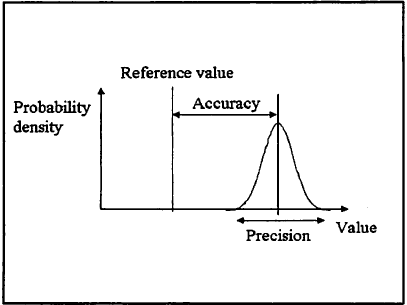
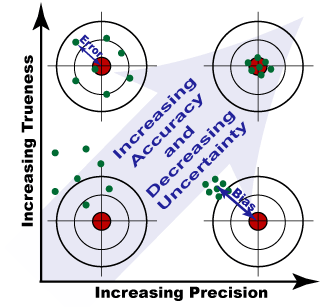
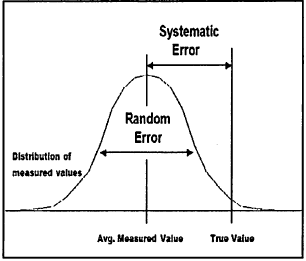
You write as to “accuracy.” Accuracy (strictly in a ICH and IUPAC way) is a particular type of assessment of a measurement. Accuracy is more properly known as “bias.” Bias is the measure of how closely the results are to the true value. It is characterized by perhaps a high Standard Deviation, but may or may not have a low average deviation from the true (actual) value.
Then there is precision. Precision is an entirely different type of animal. They are inter-related and dependent variables, but they are entirely different concepts. Precision is more properly known as “calibration.” Precision is best defined as a measure of how closely the results can be to one another. It is characterized by a low Standard Deviation, but may or may not have a high average deviation from the true (actual) value. Precision is made up of repeatability, intermediate precision, and reproducibility. Repeatability is characterized as the ability day-in and day-out using the test, using the same method on the same instrumentation on the same unknown arrives at the same result. Intermediate precision is an expression of with-in laboratory variation: different days, different analyst, etc. Reproducibility is defined as the ability of a test or experiment to be accurately reproduced, or replicated, by someone else working independently. Precision should be investigated using homogeneous, authentic samples over the long term.
There are three graphical representations that best and most simply show these concepts.


 The McShane Firm | DUI Lawyers
 Pennsylvania DUI Blog
One response to “A rose by any other name??? More on Metrology and its nomenclature”