
Contamination of a crime scene is the enemy of truth.
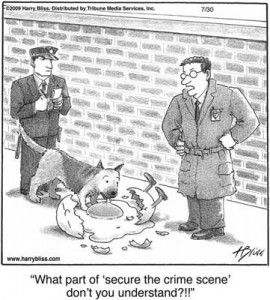
Everyone recognizes that the enemy of crime scene investigation is contamination and the altering of important physical evidence.
The federal government in the United States Department of Justice, Office of Justice Programs, National Institutes of Justice, and specifically the Technical Working Group on Crime Scene Investigation (TWGCSI) spent years of study and investigation in the late 1990s which resulted in the publishing of guidelines for crime scene investigation that recognize this salient and hopefully obvious fact. The year 2000 publication is entitled, “Crime Scene Investigation: A Guide for Law Enforcement“. This text is a useful framework and introduction into the principles and procedures in terms of best practices as to preserve and collect a crime scene to avoid altering or contamination.
A decade has passed. How has local and state law enforcement reacted?
Every police department should have a well-published and well-known and practiced Standard Operating Procedure (SOPs) in terms of the proper securing of a crime scene.
Does this happen?
At least around where I am in Central Pennsylvania, police departments generally do not maintain SOPs as to crime scenes.
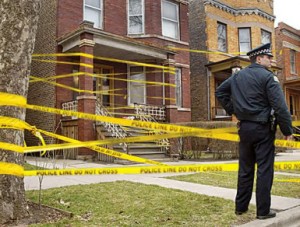
The steps that should be uniformly present in a well developed SOP as to crime scene preservation include the following:
- An acknowledgment and education to first responders of the need to be aware of physical and forensic evidence and how the theory of the Locard Exchange Principle plays into the crime scene;
- An acknowledgment that when one is called to a crime scene that the ultimate conclusions or probabilities to explain the occurrence is not known and as such one should not walk in with a cognitive bias but rather with the idea that everything may later prove to be significant and hence the need secure and preserve the scene in its original state so as to document and catalog in a measurable and meaningful way so that others who later review the notes, photos and documents who were not on the scene can use the data generated in that is it both accurate and precise. This should be the goal;
- A recognition that the order of processing a scene is important, just as the order of preserving the scene is important (e.g., the setting up of a crime scene perimeter, but also in the fashion of fingerprints in blood spatter first then blood spatter or blood spatter first then fingerprints);
- The understanding that some evidence may very well be transitory in nature such as volatile organic compounds;
- The need to immediately secure the scene as soon as possible;
- The need to secure and control persons at the scene and the acknowledgment that those at the scene who may not even be involved may themselves contain meaningful evidence on their person such as blood or particles such as gunshot residue;
- Document, document and then again document

Without a well-promulgated, well-defined, well-entrenched and universally implemented SOP for crime scene preservation, then even the best collection and analysis later will be justifiably questioned as a large mistake was made in the beginning. The old phrase garbage-in leads to garbage-out comes to mind. Without a well-preserved crime scene, we are reduced to being tourists gawking and tramping through the crime scene forever changing and altering it.


 The McShane Firm | DUI Lawyers
 Pennsylvania DUI Blog
Raymond E. Foster says:
I think you miss the first and most vital point – the definition of a crime scene. For most first responders a crime scene is a location wherein a crime occured. In reality, a crime scene is a location wherein evidence of a crime may exist. This changes the nature of the approach to each location – and, you points become even more salient. As an example, a homicide detective prepares a search warrant on a defendants home. However, the murder occurred at another location. The purpose of the warrant is to search for evidence – therefore, even though the crime did not occur at the location, it is a crime scene. Indeed, every traffic stop is a crime scene!
Justin J. McShane says:
An excellent, excellent brilliant point. I think you are dead on. If you misidentify the locus of action or where the evidence may be moved or transferred, then vital information may be lost. For example, anyone who has ever been at a shooting range more than a couple times with a semi automatic pistol knows that expelled cartridge casings from the weapon can go all over the place including one’s clothing. I can think of a number of times that after I got home I found a casing in a pocket or a fold of clothing. Valid point.