
In a series of posts, we are going to talk about Mass Spectrometry.
- Introduction-The different configurations and the Electron Impact process
- What types of mass analyzers are there?
- What type of detectors are there?
- What types of analysis can be done?
- How do you read the output?
- How do they come to a qualitative measure using software?
- How do they quantitate the results?
- Do you need chromatography if you are using Mass Spectrometry?
- Other topics of interest about GC-MS
Mass Spectroscopy can be a very, very powerful tool if used properly and if used in conjunction with chromatography (whether it is Gas Chromatography or Liquid Chromatography) can provide structural information that can lead to forensically defensible confirmation of both qualitative (what is it) and quantitative (how much is it) identification except for chiral compounds.
But just like we wrote before in the case of Gas Chromatography with Flame Ionization Detector (Why saying the sample was run on a gas chromatograph is nearly meaningless), simply saying the analysis was performed by way of Gas (or Liquid) Chromatography Mass Spectrometry is useful information, but in no way is enough to determine the sensitivity, selectivity, resolving power and the overall usefulness of the analysis.
In these series of posts, we will be focusing on Gas Chromatography with Mass Spectrometry. In the future, we will look at Liquid Chromatography with Mass Spectrometry.
One of the very first thing we have to learn is about the configuration of the entire instrumentation.
- First, we need to know what column was used in the GC as this will tell us about the theoretical separating (resolving) power of the chromatographic method.
- Second, we need to know about the means of transfer from the column to the mass spectrometer so we can tell about its diffusion. This we call the interface.
- Third, we need to know the Ion Source.
- Fourth, we need to know Mass Analyzer.
- Fifth, we need to know Detector.
- Finally, we need to know about the Analog to Digital (ACD) system and software system.
Each of these six variables can effect the output in terms of the qualitative and the quantitative results.
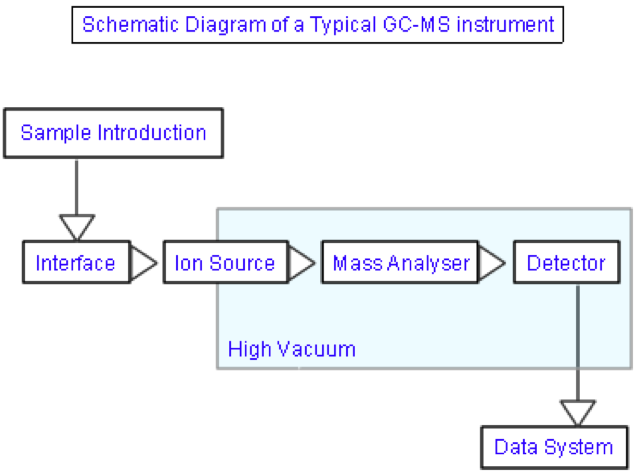
- A typical Gas Chromatography-Mass Spectrometry setup
After the basic chromatography is performed in the GC, whatever comes off the column and is transferred successfully through the interface is then ionized. All that it means to ionize something is to give it a charge. This is an electrical process (as opposed to a chemical one which is what we mostly see in Liquid Chromatography). This process occurs in the “source.”
Source: http://www.chem.harvard.edu/mass/tutorials/eimovie.html
Technically, it is in area of the source where the eluting analytes molecules coming off the column are directly ionized through collision with a bombarding electron stream emitting from a heated filament (usually made of rhenium or tungsten) resulting in the removal of an electron to form a radical cation species and us accelerated through the source to the mass analyzer as seen above. The result is that it is positively charge. As it is an “electron smashing” process, we get the name of the source from that action–Electron Impact Ionization (EI).

In the next post in our series we will look at what types of mass analyzers are there?


 The McShane Firm | DUI Lawyers
 Pennsylvania DUI Blog