
In a series of posts, we are going to talk about Mass Spectrometry.
- Introduction-The different configurations and the Electron Impact process
- What types of mass analyzers are there?
- What type of detectors are there?
- What types of analysis can be done?
- How do you read the output?
- How do they come to a qualitative measure using software?
- How do they quantitate the results?
- Do you need chromatography if you are using Mass Spectrometry?
One of the limitations of GC-MS work is actually on the GC side. GC requires volatiles and cannot analyze non-volatiles. So, whatever is going to be analyzed needs to be in the gaseous form. This is typically done either pre-injection in a process called derivatization or in the injector itself which is heated and therefore there is flash vaporization of the sample which puts it into a gaseous state.
This is opposed to Liquid Chromatography which requires the compound that we want to analyze to be dissolved or soluble.
Once we overcome this limitation on the pre-MS side of the proverbial house, then we can look at the most typical types of analysis run on EI-based Mass Spectrometry using a quadrupole: Scanning versus Selective Ion Monitoring (SIM).
Both of these techniques have their own inherent strengths and their own inherent limitations (weaknesses).
Think of scanning as like being in a big sun-room with a lot of windows. You have the ability to look over very big window out of a house. Because you have big windows, your eyes (which are really a detector if you think about it) get a big picture of everything outside. A big overview where you can admire the view. As you have a large field of vision, you may be inspired by the overall view as opposed to anything specific. You may miss the details or something selective.

- Scanning is like being in a large sun-room, you get the big picture
To do a scan on using MS is just like this. Scanning is accomplished by systematically changing the field strengths, thereby changing the m/z value that is transmitted through the analyzer. Just like looking at different specific spots with your eyes.
Strengths: It is a great method if you are analyzing a true unknown, which is what we are mostly doing in forensic analysis. Because you look over a wider view, your chances of identifying and not missing everything in the sample is much better.
Limitations:
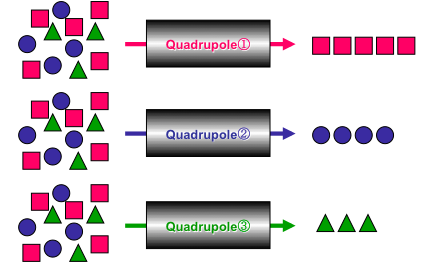
- Scan mode
Now, we have another method of analysis called Selective Ion Monitoring (SIM).
In our analogy, instead of having a bunch of windows looking over a very wide area, it is like only being able to look through a very limited area not unlike a keyhole. As a result, you only get a very limited amount of information. However, if you are only interested getting that limited amount of information and you know exactly what you are looking for and where it is, then you aren’t inconvenienced by the limited view.
 Selective Ion Monitoring is like looking through a keyhole where if you are only concerned about the color of the person’s eyes on the other side to identify the person and you don’t need the whole face in that case, then the restrictive view may be all you need
When you run in SIM, you are measuring for a specific ion. As a result other ions do not reach the detector. Since it is just a matter of whether or not the ion passes through, the analysis tube receives almost no contamination, allowing it to enduring severe analysis.
Strengths: Because you are only looking at one very specific spot and not everywhere, then the chances of us overlooking anything in that one narrow area is much, much less.
Limitations:
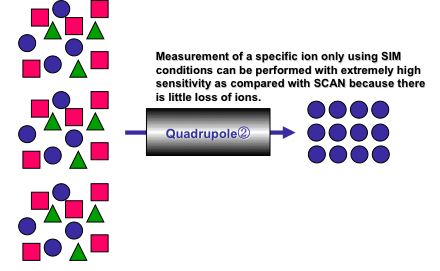
- SIM mode


 The McShane Firm | DUI Lawyers
 Pennsylvania DUI Blog