
In a series of posts, we are going to talk about Mass Spectrometry.
- Introduction-The different configurations and the Electron Impact process
- What types of mass analyzers are there?
- What type of detectors are there?
- What types of analysis can be done?
- How do you read the output?
- How do they come to a qualitative measure using software?
- How do they quantitate the results?
- Do you need chromatography if you are using Mass Spectrometry?
- Other topics of interest about GC-MS
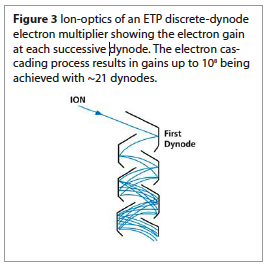
In this post, we look at the different types of detectors are used. Widely used detectors include: electron multiplier, dynode, photodiode and multi-channel plate. There is a whole lot of physics as to how this all works, but as interesting as it is, it is not particularly important for us to know or understand as that there is a difference.
Less and less analyte is reaching the detector along this process. You lose analyte in the injector port if a split injector is used. Some is lost in the transfer. Some is lost in the source. A lot is lost in the mass analyzer. So, in this final step, we typically find an electron multiplier. A electron multiplier is used to try to compensate for this loss and in doing so there is considerable amplification to get a signal.
 In our next post, we will examine the question: “What types of analysis can be done?”


 The McShane Firm | DUI Lawyers
 Pennsylvania DUI Blog