You have heard of the myth of the Horse Whisper, right?
Heck Hollywood even made a movie about it. Robert Redford was a horse trainer who could whisper and talk with the horses. They would listen and communicate with him. Pretty fantastic stuff!
There has also been the “Dog Whisperer” which is a TV series on the National Geographic Channel that has a dog trainer whose dogs exhibit behavioral problems and whispers sweet nothings into their ears and can communicate with the dog just like you and I do.
Then there is my second favorite, the Ghost Whisperer, a CBS TV drama, Jennifer Love Hewitt as a psychic who communicates with spirits.

But the criminal justice system does one better, it is my favorite brand of whisperer. It allows into evidence in a criminal trial a FIRE WHISPERER. Fire Whisperer was a phrase that I first heard coined by John Lentini of Scientific Fire Analysis.
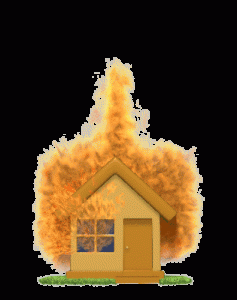
A fire whisperer typically has the following characteristics:
- under-educated, non-technically trained, high school graduate (maybe with some college)
- was trained as if by the oral tradition not unlike the Native American and Aborigine traditions by other under-educated, non-technically trained, high school graduates (maybe with some college)
- tries to make up for the lack of formal credentialed education by attending “seminars” where attendance as opposed to proficiency is the measure. These “seminars” are taught by other under-educated, non-technically trained, high school graduate (maybe with some college)
- the lack of a written protocol, policy, procedure or instructions of their method of fire investigation
- the person is a “contractor” with the lab so as to avoid the need for proficiency testing through ASCLD/LAB or ISO 17025
- lack of meaningful exposure to fire dynamics, fluid dynamics, kinetics, surface thermal effects, engineering, materials science, analytical chemistry, chromatography, physics or any hard science subject taught at a brick and mortar institution for a grade
- relies heavily upon the use of accelerant detection dogs as opposed to real VOC related analytical chemistry methods (e.g., GC-MS)
- takes little to nothing into evidence
- uses phrases such as alligatoring, char marks and the like without trying to quantify them
- resorting to the idea that the most damaged part of the area must have been where the fire started
- takes pictures of the alleged crime scene without use of principles of photogrammetry
- fails to sketch out the area
- fails to take into account the use of water on the fire scene to possibly contaminate other areas of the scene
- fails to do an investigation to see what position various items where in prior to the fire by talking with the inhabitants or looking at pictures (e.g., couch here, power stripped plugged in there)
- does not conduct an engineering study to confirm that their theory of the origin, source and fuels is even possible
- does not start with the null hypothesis that the event was not an arson, but rather starts out with the idea that it is and looks to confirm it
- does not use NFPA 921 or ASTM E603-01 or Technical Working Group on Fire and Explosion Investigations (TWGFEX) as a standard for the analysis
- the idea that the survivor of the fire must have been the person who started it
- the person accused has lead an exemplary life free of any hints of trouble
- the person accused has no motive financial or otherwise
- relying upon the fact that he/she has done hundreds or thousands of fire investigations in the past to somehow “prove” his/her method is valid
- have no known or reported error rate in their opinions or conclusions
But this isn’t just the case of www.TheTruthAboutForensicScience.com says so, but the national media has picked up on it with Stephanie Chen of CNN reporting
Junk science? Another inmate on death row fights to disprove arson
(CNN) — This is the story of two fathers who drank too much and fought with their wives but, their families say, loved their children more than anything in the world.
The two never knew each other. One was in Texas and one in Pennsylvania, but each watched a fire swallow their home with their children inside.
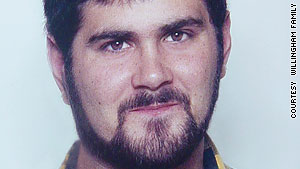
One father, Cameron Todd Willingham of Corsicana, Texas, was convicted on murder charges; authorities said he set the fire that killed his three children in 1991. He was executed by lethal injection in 2004.
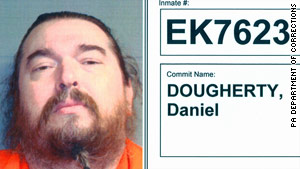
Across the country, at a prison outside of Waynesburg, Pennsylvania, where authorities say they hold the “worst of the worst,” is 50-year-old Daniel Dougherty. He, too, was found guilty of deliberately igniting fires in his home that killed his two sons, Danny, 4, and Johnny, 3, in 1985. Police arrested Dougherty 14 years later, when his estranged wife came forward and claimed he confessed. A jury found him guilty on capital murder charges in 2000.
He is awaiting death.
Daniel Dougherty, 50, is being held on death row in Pennsylvania. He is appealing his case.
Last month, a Texas state board admitted in a preliminary report that flawed arson science was used in Willingham’s investigation.
Read about the Texas state board admitting to using flawed science in the Willingham case
The board’s announcement raises a frightening question: Could the state of Texas have executed an innocent man?
Like Willingham, Dougherty has maintained his innocence from the start. He is trying to prove he isn’t responsible for the flames that engulfed his house and that he is also the victim of flawed arson science.
“We have an innocent man on death row who has been languishing there, and there is absolutely no evidence that a crime occurred,” said his attorney, David Fryman. “We’ve been trying our best to right that wrong.”
Todd Willingham said he was innocent but was executed in February 2004 for the arson murders of his three kids.
….
With science on his side, Dougherty hopes the court will set him free — before it’s too late. No execution date has been set.
Dougherty’s version of the blaze doesn’t paint him as a murderer but as a failed hero, who tried twice to rescue his sleeping sons with a watering hose and ladder, according to court records. By the time authorities extinguished the fire, his sons had already died from inhaling the toxic fumes.
….
Is arson science to blame?
John Lentini and Angelo Pisani — two of the country’s renowned arson investigators — have conducted thousands of fire scene inspections. Five years ago, they received a call from Dougherty’s attorneys.
Separately, the investigators combed through the reports, testimony, photographs and other evidence from the original fire scene. Contrary to the fire investigator’s original report in 1985, Lentini and Pisani argued there were no signs of arson in Dougherty’s home. Such expert testimony was never presented by Dougherty’s attorney in his 2000 trial.
In the last two decades, advances in arson science have spurred some investigators and lawyers to question past arson convictions. Some attorneys estimate dozens or even hundreds of cases may have been based on faulty arson science. There are no figures on how many arson cases have been successfully refuted.
Dougherty’s original attorney gave a statement in the appeal that he didn’t seek assistance from outside fire investigators. He admitted in Dougherty’s appeal that his team had “presented little from which to make an argument for life.”
The National Fire Protection Association, a fire safety organization, reported there were more than 200,000 intentional fires set to structures in 1980. In 2007, that number dwindled to 55,000. Arson investigators say the steady decline of arson cases can be interpreted different ways: Either there are dramatically fewer cases of intentional fires, or arson science has reduced the number of fires being categorized as intentional. This suggests that some previous cases deemed arson may not have been, they say.
What is a flashover fire?In their report on the Dougherty case, Lentini and Pisani say they believe Philadelphia Assistant Fire Marshal John Quinn, who led the initial probe, relied on outdated arson investigation techniques.
In his 1985 report, Quinn had determined three fires took place on the first floor of Dougherty’s brick home: one by the sofa, another by a love seat, and a third under the dining room table.
Quinn concluded only a person could have set the fire in three separate places. Quinn declined CNN’s request for an interview.
“There is no evidence to indicate it is arson,” said Lentini, who provided an expert report in Dougherty’s 2006 appeal and also reviewed the Cameron Todd Willingham case in 2004. “The only evidence he [Quinn] has is his three points of origin and those three points of origin are a figment of his imagination.”
Pisani and Lentini argue that the multiple burning spots were likely the result of a “flashover” — a naturally occurring phenomenon during a fire. In a flashover, the enclosed room can get very hot, reaching temperatures as high as 1,100 degrees Fahrenheit. The room eventually combusts, resulting in various burning points.
Flashover fires can be mistaken for arson because they leave the appearance of multiple points of ignition, they said. Lentini added Pennsylvania is “on their way to executing an innocent man.”
Pisani and Lentini also reported the origin of the fire could not be determined because of extensive damage to the room.
The Philadelphia District Attorney’s Office rejected Dougherty’s claims of innocence. They said a flashover fire requires an enclosed space, but that Dougherty’s living room, where the fire occurred, was not an enclosed space since there was a stairwell. They also argued Dougherty managed to emerge from the house without burns or signs of smoke inhalation.
…
The Dougherty trio: ‘Danny loves kids’
Daniel Dougherty, son of a Philadelphia police officer, was born in 1960 and grew up in a working-class neighborhood with five siblings.
Known as the “outgoing” middle child, he made friends and girlfriends easily. His father’s death from heart problems crushed the 14-year-old Dougherty, who began to drink.
Dougherty never finished the 10th grade. He met his first wife, Kathy Fox, and they had their first son, Danny, in 1980. Two years later, they had their second boy, Johnny.
Danny, 4 years old at the time of the fire, was fearless and curious. He liked riding roller coasters with his father. He constantly peppered family members with questions. Johnny, 3, was quieter.
Dougherty was a functioning alcoholic, his family says. He rarely missed a day of work as a mechanic, his family said. He brought his sons to work so they could spend more time together.
“Danny loves kids, no matter whose kids they are,” said his older brother, Norman Dougherty, 57, of Philadelphia. “He loves my kids, his nieces and nephews. He’d take them to the park. He was good like that.”
Dougherty’s older sister, Karen Dougherty, 53, invited them over for Sunday night dinners at her home. She said her brother relished in his role as a father. He was the first to take his children — and hers — sledding each winter.
“Our father passed away when my brother was young so he always had the kids close to him to make sure nothing would happen to them,” she said.
On August 24, 1985, the night of the fire, Dougherty was supposed to be at an Alcoholics Anonymous meeting. He skipped the meeting and instead went to a bar, where he got into a verbal argument with his girlfriend at the time (she was not the mother of the two boys). He came home, made himself dinner and fell asleep on the sofa in his living room, according to his testimony at trial. He said he awoke to see the curtains in flames. His children were asleep upstairs.
He ran outside to get the neighbor’s garden hose, but the hose was too short. He tried to get water near the window of the house, but he was too late. Flames were already bursting from the house.
The glass exploded, cut his arm and pushed him down.
Next, he grabbed a wooden ladder. But the fire was too powerful. He testified it “blew him down.”
“He was so destroyed,” said Judy Sorling, 54, who still lives several houses away on Carver Street where the fire took place. She told CNN she saw Dougherty standing with the hose, attempting to put the fire out. “He kept yelling for help.”
When firefighters arrived, Dougherty was frantic, screaming at police to save his children. His aggressive and erratic behavior worried police. Authorities shoved his face in the mud and he was taken away, court documents say. Dougherty testified he wanted to die at that moment.
Authorities sifted through the charred remnants of the home and determined the fire had been intentionally set.
Police questioned Dougherty and his family members, but no arrest was made.
Are arson investigations an art or science?
Scenes from popular television shows like CSI often depict detectives relying on forensic science and lab work to draw conclusions. But in the realm of arson investigations, experts say science has played a small role until more recently.
Until 1992, some arson experts say, guidelines for determining arson were largely based on hand-me-down myths practiced by fire investigators with little formal training. In 1992, the National Fire Protection Association released its first arson guidebook based on years of studies and simulations.
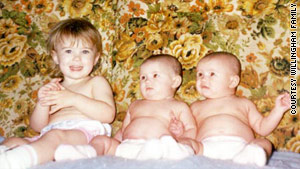
Killed in the Willingham fire were stepdaugher Amber, 2, and twins Karmon and Kameron, 1.
The guidelines, known as NFPA 921, were initially met with resistance from fire marshals and officers across the country, who believed arson investigations were an art rather than a science.
“It was gumshoe work, not really analysis and conducting studies,” said Gerald Hurst, an arson investigator with a Ph.D. in chemistry, who examined the arson findings in the Cameron Todd Willingham investigation from 1991. He concluded the arson science used in his case was “junk.”
In 2006, Hurst independently examined Daniel Dougherty’s case. Hurst, too, believed that the multiple burning points were the result of a flashover fire.
The fire that killed three people in the Willingham case in Texas happened in 1991, a year before NFPA 921 was released. In February 2004, Willingham was executed. Later, three reviews of evidence by outside experts concluded the fire should not have been ruled arson. The reports stated a flashover was likely responsible for the fire at Willingham’s home.
Read about Texans wondering if they executed an innocent man
“There can no longer be any doubt that an innocent person has been executed,” said Barry Scheck, co-director of the Innocence Project, which uses DNA evidence in efforts to prove the innocence of people they believe were wrongly convicted. “The question now turns to how we can stop it from happening again.”
From prison, a father waits for a second chance
In the years after the fire that killed his two sons, family members said Daniel Dougherty changed. His addiction to alcohol intensified as he tried to cope with his loss. He eventually divorced his wife and remarried, then divorced again.
Dougherty received a surprise visit from police in 1999, about 14 years after the fire. His second wife, Adrienne Sussman, had reported to police that he confessed to using gasoline in the fire. Dougherty was arrested.
Sussman’s claim should have been dismissed because no fire reports showed accelerants had been used, Dougherty’s attorneys argued. At the time Sussman went to police, she was engaged in a custody battle with Dougherty over their son Stephen, court documents say.
Prosecutors supported their case with the statements of two jail house informants who said Dougherty confessed to them in his cell. But Dougherty’s attorneys say the jail house informants are unreliable. They point to studies that show in-custody informant testimony is a leading cause of wrongful conviction in capital cases.
Dougherty’s first wife and the mother of the deceased children, Kathy Fox, is now remarried. She said she doesn’t believe he intentionally killed their children. She never testified in the original trial because Dougherty’s attorney didn’t ask her.
“Knowing Daniel and his relationship with his children, I cannot believe he would have burned them to death,” she said in statement presented in Dougherty’s appeal.
So how do lawyers prove a man’s innocence more than two decades after a fire occurred?
The task is almost impossible, said David L. Faigman, a law professor at the University of California, San Francisco. Disproving an arson case is more challenging because the findings aren’t as clear-cut as DNA, he said. He said the petitioners have the burden to prove the arson didn’t occur and that they weren’t involved.
“Courts are already reluctant to open old cases without something like DNA that is really demonstrative proof of someone’s innocence,” Faigman said.
Cameron Todd Willingham’s family in Texas is on a quest to prove he is innocent. While the Texas state board’s preliminary findings admitted to flawed science, they also found the investigators did not commit negligence. Still, his family is hoping the board’s final findings, expected to be released in October, will exonerate him.
“It will help us with public opinion,” said Dougherty’s attorney at Ballard Spahr, about the Texas state board’s initial announcements. “I think it can serve as a persuasive influence that this is the real issue. It’s a scientific issue, and we don’t want to have another Willingham.”
Dougherty’s fate rests in the Pennsylvania Supreme Court, which could take years to make a decision. If the Pennsylvania Supreme Court denies his post- conviction relief, his attorneys say they will have to go to federal court.
Meanwhile, Daniel Dougherty marks his time on death row in Pennsylvania. He’s in solitary confinement. At 4 a.m., he is awake and listening to the radio through his headphones. By 5 a.m., he says a prayer and starts his routine of medicines for a number of ailments, including stomach problems. He’s worried about whether his body will hold out long enough to prove his innocence.
His food comes through a locked slot on his cell door. He plays dominoes most days. TV helps him get through. On Mondays, Wednesday and Fridays, he exercises.
He occasionally receives letters from his common-law wife, Kathy Halin, and his family. They are too poor to visit him on the opposite end of the state.
Johnny and Danny, his sons who died in the fire, remain a topic of conversation that evokes “severe hurt,” he said.
“I LOVED (and still do) my sons more than life itself,” he wrote.
He added in his letter that time may heal wounds, but nothing can heal this one.
Once again, we should demand that real science be presented in the Courtroom and that science fiction remain in the movies.


 The McShane Firm | DUI Lawyers
 Pennsylvania DUI Blog
kim boyer says:
http://www.helpstopfraud.org/FightingInsuranceFraud/RecognitionofPartnersandAwardees/tabid/98/Default.aspx
Justin, Is is not funny how so many of the individuals in question in your article, including Detective Dennis Woodring, were actually “honored” at the 2010 Pa Fraud Prevention Dinner? Follow the link above to see for yourself what a good ole boys club we really have in Harrisburg.
Keep fighting McShane, we need you!
Justin J. McShane says:
Thank you for your words of encouragement. It is about exposing the truth and the limitations of forensic science. If it is valid work, it will be celebrated. If not then it will be exposed.